Loading...

Supporting developers, startups, and full-fledged companies building on Stellar and Soroban
© 2026 Stellar Development Foundation
Subscribe to the Newsletter

By Nectar Network

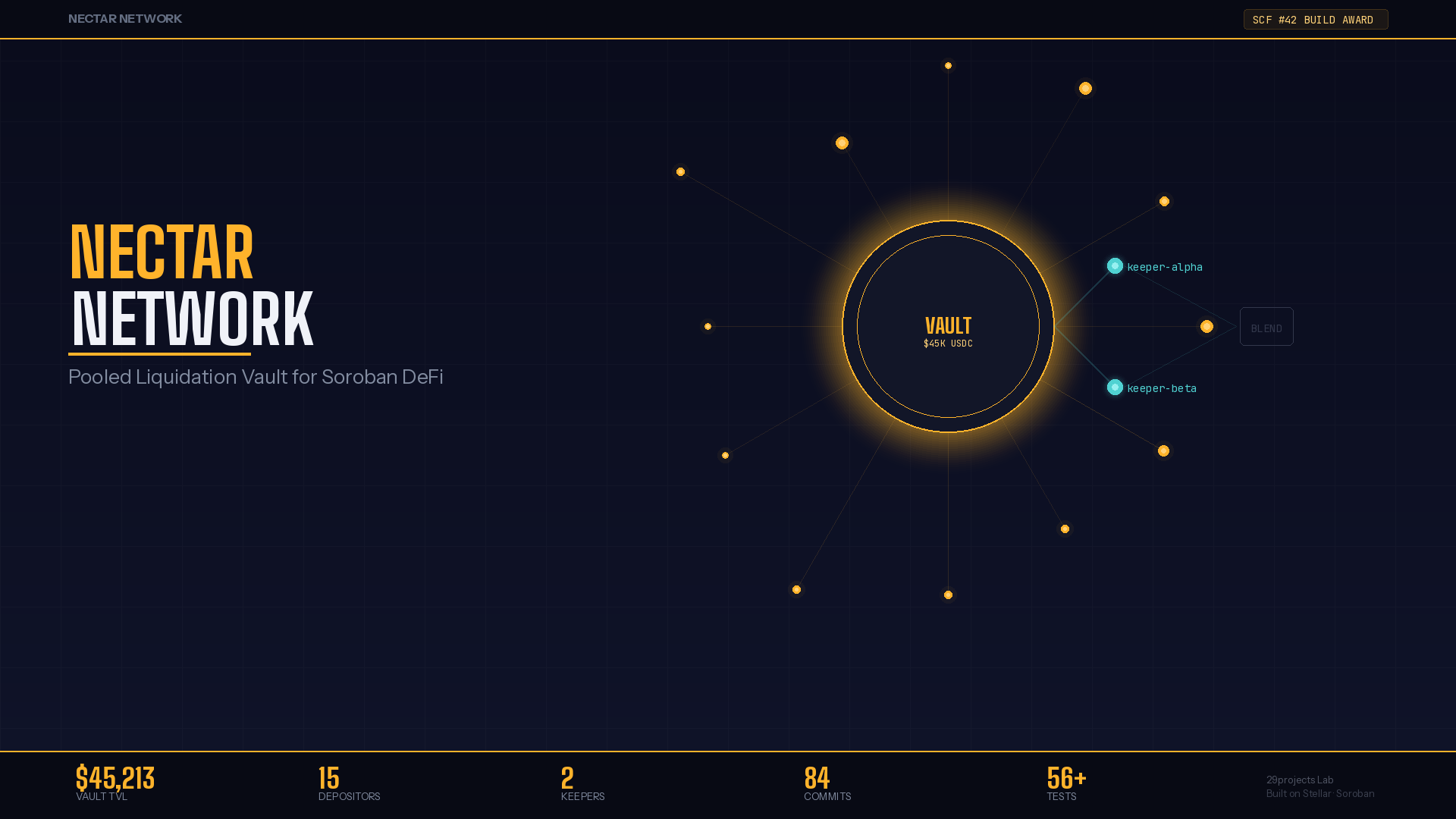
Nectar Network is a liquidation protocol for Soroban DeFi. Users deposit USDC into a shared vault to earn yield from automated liquidation activity. A multi-operator keeper network draws pooled vault capital to fill Blend Protocol liquidation auctions, sells seized collateral, and returns proceeds — generating yield for depositors while keeping lending markets solvent.
Live on Soroban testnet today with $45,213 USDC TVL, 15 real depositors, and 2 registered keeper operators.
This submission funds three phases to reach mainnet:
Phase 1 — Vault & Keeper Hardening
Keeper staking requirement (operators deposit USDC to register, slashable on failed execution), vault deposit caps, withdrawal cooldowns, and full Blend auction integration with retry logic.
Stellar usage: All staking, slashing, and vault accounting runs as on-chain Soroban contract state. Keeper verification uses cross-contract calls between NectarVault and KeeperRegistry. Blend auction creation and fill are direct Soroban contract invocations.
Impact: Production-grade vault and keeper contracts ready for real capital. Staking creates accountability — keepers have skin in the game.
Phase 2 — DEX Integration & Multi-Protocol Support
Soroswap/Phoenix DEX integration for automatic collateral-to-USDC conversion after auction fills, multi-protocol adapter interface (Blend + DeFindex), monitoring dashboard with APY history and keeper leaderboard, open-source keeper SDK.
Stellar usage: DEX swaps execute as Soroban contract calls through Soroswap router. Adapter interface allows any Soroban protocol to register keeper tasks. Dashboard reads vault and registry state from Soroban RPC. SDK wraps the official SDF Go SDK (github.com/stellar/go).
Impact: Closes the liquidation loop — keepers automatically convert collateral to USDC without manual intervention. Multi-protocol support means Nectar becomes shared infrastructure, not Blend-specific.
Phase 3 — Mainnet Launch
All contracts deployed to Stellar mainnet with Circle USDC, oracle circuit-breaker module cross-referencing Reflector data, Dockerized keeper with one-command setup, operator documentation, security hardening (withdrawal rate limits, draw caps, admin multisig), and published performance benchmarks.
Stellar usage: Mainnet contracts settle with ~5s finality. Oracle circuit breaker queries Reflector (Stellar-native oracle) to detect price manipulation — directly mitigating the attack vector from the Feb 2026 YieldBlox exploit. Emergency pause mechanism on all contracts.
Impact: Stellar gets its first pooled liquidation protocol on mainnet — filling an infrastructure gap that exists across the entire ecosystem. Depositors earn yield, keepers earn execution rewards, and lending protocols get redundant liquidation coverage.
_ _
$75.0K
On-chain evidence (Soroban Testnet — all verifiable on stellar.expert):
KeeperRegistry: https://stellar.expert/explorer/testnet/contract/CAWT5HBM25OKGOMJHPFCXWXDWZ7FF436WXRKROTY2VW642FSKLYUKOUB
NectarVault: https://stellar.expert/explorer/testnet/contract/CCXDLRE3IV5225LE3Z776KFB2VWD2MTXOJHAUKFA5RPYDJVOWCMHJ4U4
USDC Token (SAC): https://stellar.expert/explorer/testnet/contract/CAVBAVD6CZ46FEDKJHBQIJF7EFAZDTRNS65G73QS5ZYI3VK5E2JFPQ4J
Vault TVL: $45,213 USDC across 15 unique depositor addresses (all on-chain, verifiable). 2 keeper operators registered (keeper-alpha + keeper-beta).
Codebase: 84 commits (Jan 6 — Mar 14, 2026). 2 Soroban smart contracts (Rust), Go keeper daemon, Next.js 14 frontend. 26 contract tests (9 registry + 17 vault), 30+ Go tests (unit, integration, stress, benchmarks). All pass with cargo test and go test -race ./.... GitHub Actions CI configured. Docker Compose for 3-service stack.
Live frontend: https://nectarnetwork.fun — Home (live keeper log stream via SSE, architecture diagram, on-chain keeper registry), Features (5 core features, getting started guides), Vault (Freighter wallet deposit/withdraw with Stellar Expert tx links), Performance (15 real depositors, keeper stats, vault TVL).
Live keeper API: https://nectar-keeper.onrender.com — REST endpoints (/api/state, /api/performance, /metrics) serving real-time keeper data to the frontend.
Market validation: Stellar DeFi holds ~$187M TVL. Blend Protocol alone holds ~$80M. Zero multi-operator keeper infrastructure exists on Soroban. The Feb 2026 YieldBlox exploit ($10.8M drained via oracle manipulation, 60 auction fills over 4 hours, only 2 pre-positioned bots) demonstrated the critical need for distributed, redundant liquidation infrastructure. Blend's liquidation bot is a single-operator Docker container with an explicit disclaimer: "not guaranteed to be profitable and may result in financial loss."
Team track record: Delivered $10K Polkadot Fast Grant (PowerGrid Network — 4 ink!/Rust smart contracts shipped to mainnet, completed on time). Won UN COP'24, Soonami Venturethon, Solana SuperteamDE hackathons. Deep Rust/WASM and Go expertise directly applicable to Soroban development.
KeeperRegistry v1 — Staking & Performance Tracking
Upgrade KeeperRegistry with operator staking requirement (keepers deposit configurable USDC minimum to register). Add performance tracking: execution count, success count, average response time per keeper stored on-chain. Implement slashing: if a keeper draws vault capital and fails to return proceeds within configurable timeout, a portion of stake is transferred to vault as compensation.
Measurement: Staking enforced on-chain (registration fails without sufficient deposit). Performance metrics queryable per keeper address. Slashing triggers automatically on timeout. Unit tests pass for all staking/slashing scenarios.
Budget: $4,500
NectarVault v1 — Production Deposit/Withdraw Logic
Upgrade NectarVault with deposit caps (configurable maximum TVL), withdrawal cooldowns (minimum hold period to prevent deposit-and-withdraw arbitrage), and hardened share price accounting covering edge cases: rounding at 7 decimal precision, zero-share scenarios, concurrent draw+withdraw race conditions.
Measurement: Deposit cap enforced — deposits rejected when TVL exceeds configured max. Withdrawal cooldown enforced — withdrawals rejected if deposited less than configured period ago. 10+ new unit tests covering all edge cases pass. End-to-end deposit/withdraw flow recorded on testnet.
Budget: $4,500
Blend Liquidation Adapter — Full Auction Integration
Complete integration with Blend Protocol's liquidation auction system. Handle all Blend auction types: user liquidation, interest, and bad debt auctions. Implement Dutch auction profitability evaluation (lot/bid ratio over 200-block decay). Add retry logic for failed transactions, sequence number conflicts, and Soroban resource exhaustion errors.
Measurement: Keeper successfully creates and fills user liquidation auctions on Blend testnet pools. Interest and bad debt auctions detected and filled when profitable. Failed transactions retried with exponential backoff (max 3 retries). End-to-end recorded demo: deposit USDC → keeper detects underwater position → draws from vault → fills Blend auction → returns proceeds → depositor balance increased.
Budget: $6,000
DEX Integration for Collateral Conversion
Integrate with Soroswap and/or Phoenix DEX for automatic collateral-to-USDC conversion after auction fills. When a keeper receives non-USDC collateral (XLM, ETH, etc.) from a Blend auction, the keeper automatically swaps it to USDC via DEX before returning proceeds to the vault. Slippage protection with configurable threshold.
Measurement: Keeper fills a Blend auction receiving XLM collateral, swaps to USDC on Soroswap testnet, returns USDC to vault — all in a single automated cycle. Swap rejected if slippage exceeds threshold (default: 1%). Recorded demo showing the full collateral conversion flow.
Budget: $7,000
Multi-Protocol Adapter Interface
Abstract Blend-specific liquidation logic into a generic adapter interface that any Soroban protocol can implement. Build a second adapter for DeFindex vault rebalancing as proof of extensibility. Document the adapter interface for third-party protocol teams.
Measurement: Adapter interface defined with clear trait pattern in documentation. DeFindex adapter detects vault drift and triggers rebalancing via keeper network. Both Blend and DeFindex adapters running simultaneously on testnet. Adapter development guide published.
Budget: $6,500
Monitoring Dashboard v2
Upgrade frontend with vault APY history chart (historical returns over time), keeper leaderboard (ranked by execution count, success rate, total profit generated), liquidation event feed (real-time stream of executed liquidations with amounts and tx links), and depositor analytics (individual deposit history, yield earned).
Measurement: APY chart renders historical vault returns. Keeper leaderboard ranks all registered operators by performance. Liquidation feed streams events in real-time. Depositor page shows per-address deposit/withdrawal history and cumulative yield.
Budget: $5,500
Open-Source Keeper SDK & Operator Documentation
Package the Go keeper client into a reusable SDK that third-party operators can use to build custom keeper strategies. Publish as a Go module. Write operator setup guide, strategy configuration reference, risk management guide, and testnet sandbox instructions.
Measurement: Go module published and importable via go get. Documentation covers setup (<10 min), configuration, strategy examples, and troubleshooting. At least 3 keeper operators running simultaneously on testnet using the SDK.
Budget: $3,500
Mainnet Deployment
Deploy NectarVault and KeeperRegistry to Stellar mainnet. Configure production parameters (deposit caps, withdrawal cooldowns, staking requirements, slashing rates). Integrate with mainnet Circle USDC. Set up production keeper infrastructure with uptime monitoring, alerting, and automatic restart. Test and verify emergency pause mechanism.
Measurement: All contracts deployed to Stellar mainnet with published addresses and Stellar Expert links. NectarVault accepts mainnet USDC deposits. Production keeper running with 99%+ uptime and monitoring alerts. Emergency pause tested and functional on mainnet.
Budget: $12,000
Oracle Circuit Breaker Module
Implement price sanity checks that cross-reference keeper-observed prices against Reflector oracle data on-chain. If deviation exceeds configurable thresholds, automatically pause liquidation execution for the affected asset. This directly mitigates the oracle manipulation attack vector from the Feb 2026 YieldBlox exploit.
Measurement: Circuit breaker triggers when price deviation exceeds threshold (default: 5% from Reflector). Per-asset and global pause mechanisms functional. Tested against simulated oracle manipulation scenarios on testnet before mainnet deployment. Oracle health endpoint exposing per-source status and deviation metrics.
Budget: $8,000
Operator Onboarding & Docker Packaging
Package the Go keeper as a Docker image with one-command setup. Write comprehensive operator documentation covering installation, configuration, strategy tuning, risk management, and troubleshooting. Create testnet sandbox with mock Blend pools for new operators to practice before committing mainnet capital.
Measurement: Docker image runnable with docker run and environment variables only. Operator guide enables setup in under 10 minutes. Testnet sandbox operational for practice. At least 5 keeper operators running on mainnet within 2 weeks of launch.
Budget: $7,500
Security Hardening & Performance Benchmarks
Comprehensive security review of all contracts and keeper client. Implement vault withdrawal rate limiting (max per address per 24h), keeper draw limits per cycle, and admin multisig for critical operations (pause, parameter changes). Measure and publish performance benchmarks: detection-to-fill latency, concurrent liquidation throughput, vault operation gas costs.
Measurement: Rate limits enforced on-chain. Admin multisig configured and tested. Published benchmark report documenting average detection-to-fill time, maximum concurrent liquidations, and gas costs per operation. All edge cases tested: simultaneous liquidations, vault exhaustion, oracle failures, keeper conflicts.
Budget: $10,000
3-person team with a delivered blockchain grant and deep Rust/WASM expertise:
Kunal Drall — Founder & Lead Architect (LinkedIn) Founder of 29projects Lab, New Delhi. B.Tech CSE, focus on security and applied cryptography. Delivered $10K Polkadot Fast Grant (PowerGrid Network — 4 ink!/Rust contracts, mainnet). Won UN COP'24, Soonami Venturethon, Solana SuperteamDE. Built DeFi infra: CDP engines, liquidation logic, vault strategies, 128-bit precision math library.
Daksh Drall — Smart Contracts & Backend (LinkedIn) Co-built PowerGrid's ink! contracts. Rust-native developer with integration testing and deployment experience. Leads Soroban contract dev, protocol adapter integrations, and keeper client.
Priya — Frontend & UX (LinkedIn) Builds dApp interfaces with React, wallet integrations, and real-time dashboards. Leads monitoring dashboard, operator onboarding, and protocol health visualizations.
Lean, AI-augmented team — proven during PowerGrid where we shipped at 5-person velocity using AI tooling for architecture, docs, and code generation.


Priya


Daksh drall
29projects Lab
Kunal
No other submissions.